
"Odessa School of Art" and "The Odessa Group"
(Distinctions in terminology)
|

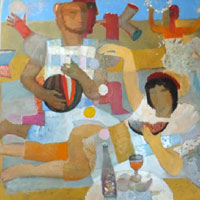
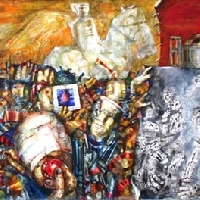
Ludmilla Yastreb
Five Females, 1978
69x56cm
(27 1/4"x22 1/8") Private Collection
|
If the visual arts of Moscow and St. Petersburg (Leningrad) have become relatively known in the West due, mainly, to the continuous, successful sales of Russian art by major Western auction houses and to the fast developing internal art markets in Russia, the artistic life of the regions still presents a very fragmented and often much distorted view.
Yet the art from the city of Odessa (Ukraine) has often been praised by art aficionados
around the world.
Odessa, a port city on the Black Sea had been founded by the Russian Empress
Catherine II (the Great) in 1794. Before the 1917 Revolution the city was part
of Southern Russia and at present it is the territory of the Ukraine. Odessa
has always been the city of sailors, merchants, musicians and painters. Below is a brief review of the Odessa school of painting.
Towards the end of 19th century there had developed a local school of art represented
by the creative group of the Southern Russian artists – “The Association
of the Southern Russian Artists” (TYURKH). Their merit was in that they
had discovered, entirely on their own, their version of Impressionism –
colouristically subtle “en plein air” painting, which was made largely
possible due to the unique natural environment of the Odessa region.
At the turn of the 20th century the artistic life of Odessa had been growing
and developing at a rapid speed. The Odessa artists had close contacts with
the cultural centres of Russia and Europe. Not being content only with their
own developments, they were open to the new trends and experiments exploding
around them at the time. It is from Odessa that such stars of the Art world
as Vassily Kandinsky and David Burliuk had sprung from. Unfortunately that blossoming
was put down by the communists after the October Revolution and came to an abrupt
end followed, one by one, by social and cultural catastrophies which the Bolshevism
brought with it. Still, in spite of that, the creative life of the city was
not completely destroyed. The artists could not continue with their innovations
and so their main task became the preservation of the tradition of the Odessa
school of painting and so the theme of the fine impressionistic painting had
managed to survive.
The next explosion took place in the 1960s, in the time of the so called “Khrushchev’s
Thaw”. Having had just a tiny taste of freedom, the country had started to show signs of a
revival. Odessa, always dynamic and responsive had also made its contribution
to the change. In the early 1970-s there had already formed a group of young
artists who refused to follow the official line and who put all their creative efforts into developing
their own style of art according to their vision and their ideals. Gathering bits and pieces of scarce information
on the artistic developments in the West, they experimented with the form and
searched for their own artistic language.
Rejecting the traditional approach, so characteristic of the early Odessa painting,
they understood a work of art, whether abstract or a figurative painting, as
a world in itself with its own laws. The destiny and the path of this generation
of artists was a dramatic one. Towards the middle of 1970s, these artists became the
object of the ideological process. Their creative search had been viewed by Soviet power as
a decadent regression and equalled to the disloyalty. There began a confrontation
between the authorities and the most active artistic personalities. They were
not allowed to exhibit their artworks in public places and they would not be accepted to the Union of Artists and that, practically, sentenced them to some sort of an illegal existence.
And so the phenomenon of the ‘underground art’, provoked by the
stupidity of the Soviet system, was born. The artistic process in the Soviet
Union became split on the officially accepted artists – who were mostly the
members of the Union of Artists, and among whom could be found many true masters of painting,
and the nonconformists who as a rule were young, dissatisfied with the official
line, artists. But you cannot stop a true artist from creating and showing his/her art, so he/she finds a way! If they can’t exhibit officially, publicly they can still
exhibit privately. Thus the “Apartment Exhibition” movement was
born.
The Odessa artists, like their counterparts in Moscow, began to show their
art to a selected audiences initially in their private apartments and later in
the apartments of their friends and admirers. Officially, nobody could prevent
them and the organizers of such exhibitions from inviting their friends, relatives,
colleagues and anyone interested to their homes to see the artists’ latest
achievements. Of course, not without a certain amount of risk as such an activity
in those years was bound to be frowned upon by the KGB and incur pressure and
anger from the top. Most of these artists had already become close friends
and now their artistic impulse brought them even closer together.
By the mid 1970s, in Odessa, a core group of nonconformist artists was formed
whose most active members were: Vladimir
Strelnikov, Alexander
Anufriev, Valentin
Khrushch, Victor
Mariniuk, Lyudmila
Yastreb, Stanislav
Sytchev, Evgeni
Rakhmanin, Ruslan
Makoev and others. These artists continued to create and show their art
privately inspite of the constant harassment from the authorities and the oppression
and hatred coming from the majority of the officially recognised artists.
They had close connections with the Moscow centres of the underground art movement
and were participating in the apartment exhibitions of nonconformist art in Moscow and in Leningrad.
They also invited their Russian colleagues to visit Odessa and to take part
in their apartment exhibitions there. That underground artistic activity had created
a number of forward thinking personalities who had offered their homes for these
exhibitions.
From the mid-1970s, the nonconformist artistic activity in Odessa centred in
the private apartment of Vladimir Asriev, a professional violinist and enthusiastic
art collector, where the exhibitions by the Odessa nonconformist artists became
a regular feature. His apartment became a unique artistic environment open to
all creative personalities and to the curious public. In 1976, to the great annoyance of the Odessa KGB he issued as a samizdat - "Catalogue of the Collection of Vladimir Asriev". This included about 100 artworks, representative of almost every nonconformist Odessa artist. During this period, he was also behind many private exhibitions of nonconformist artists, including an exhibition of "Ukrainian Contemporary Painting" in 1977 at his apartment transformed into an "unofficial gallery" in the city centre. Inspite of continuous harassment and threats from the Soviet authorities during the 1970s he managed to keep his flat an open house for local artists, musicians and poets. Since settling in England in 1980, Asriev has been behind many exhibitions of Russian and Ukrainian art.
The three periods concerning the development of the Odessa art mentioned above
didn’t evolve sequentially. In the second half of the 20th century there
were those who continued the ‘en plein air’ tradition alongside
the representatives of the so called “Severe Style” in Soviet painting
- the shestidesyatniki, and, finally, the nonconformists, the ones who found
themselves in the zone of the unofficial art.
In each of those categories there were true, deservedly admired maestros
of painting with the majority of artists just following the trend, conforming
to the ideological line in the pursuit of their own mercantile goals. The consciencsious
researcher ought to make an effort and try to distinguish between those categories
in order to present that period of the Odessa art history in its true context.
For that a certain terminology has been suggested. At present, there are two widely used definitions: "The Odessa School of Art" and "The Odessa Group".
The name "Odessa Group" was introduced, for the first time, by art critic, Myroslava Mudrak, in 1979 for the moving exhibition - "Ukrainian Contemporary Art", Munich, London, New York, Paris'. The former can be applied
to all of the Odessa traditionalist style of painting beginning from the time
of TYURKH. Really, if we were to observe any period or any stylistic direction taken by the Odessa artists we would inevitably notice something in common in all of
them - it is, firstly, a life-affirming attitude, the colourist preferences
and that specific something that could be called “the spirit of the region”.
The terms “The Odessa School” and “The Odessa zhivopis’
(Painting)” are often being used in relation to the en plein air, impressionist
tradition. Although, in our opinion, it would be more correct to unite these
two terms under one - “The Southern Ukrainian Impressionism”, which
represents a long line of well known names in the Odessa art such as Kostandi,
Golovkov, Dvornikov, Sinitsky and in the second half of the 20th century: Konstantin
Lomykin, Gennadi
Malyshev, A.Gavdzinsky and the more contemporary, Vladimir Litvinenko. Naturally these are by no means the only representatives of the
term.
The term - “The Odessa Group” defines the circle of the avant-garde
artists and has been associated with the nonconformist artists who were the
core of the Odessa underground movement in the early 1960s and throughout 1970s.
Among them were the already mentioned above: Vladimir
Strelnikov, Alexander
Anufriev, Valentin
Khrushch, Victor
Mariniuk, Lyudmila
Yastreb, Stanislav
Sytchev, Evgeni
Rakhmanin, Ruslan
Makoev who were later joined by Vladimir
Tziupko, Alexander
Stovbur, Valentin
Shapavlenko, Vladimir
Naumetz, Vitaly
Sazonov, Valery
Basanietz, Oleg Voloshinov, Andrey
Antonyuk, Sergei Savchenko and others.
Aesthetically, these artists hold very different, diametrically opposite views
to those followed by the more traditionalist Odessa artists and their other
contemporaries such as K.Lomykin,
A.Gavdzinsky,
V.Litvinenko
and others. And, although on a deeper level all of the
finest Odessa painters share the painterly qualities of the Odessa school of art,
they can’t be grouped together under one term. It was only logical that
they had always exhibited separately.
These are just some elementary facts about the Odessa Art phenomenon. The ever growing artistic authority of Odessa demands a thorough and professional research of the available resources. We hope that the facts given in this short article
would help those who wish to learn more about the artistic talents of the unique
city of Odessa.
Olga Savitskaya,
Art critic,
Odessa, St.Petersburg
Light, Lucidity and Freedom
|

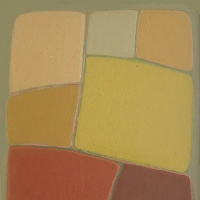
Yegorov, Yuri
Gold and Silver, 1985
120x121,5cm
(47 1/4"x47 3/4") POA
|
The city of Odessa is arguably the most important
artistic centre in the Ukraine. Its landscape stands firmly within
the artist's field of vision, transformed into a creative image
by figurative experiment. Indeed, with its spectacular topography
and pan-meditteranean, Odessa has long been an inspriation to the
great painters, who exploit the bright sun filled colours of the
Odessa landscape. Odessa painters are able to capture the purest
elements of art, exploiting not just the airy brightness typical
of the city but also the rectilinear and cursive shapes of rock
formations along the shores of the Black Sea and even the expanse
of the shoreline repeated in horizontal stripes on their canvasses.
The importance of light in their work can not be
overstressed. The unique qualities of light on the Black Sea shore
have caused artists working their to deploy a diversity of spacial
solutions and to develop special notions of plasticity to convey
volumes and outlines. Formal experiment with light developed during
the 1970's in contrast to the deepening gloom of social reality
and the slow decline of national consciousnes; the works of Odessa
artists more and more are imbued with the strongest sensations of
purifying, cleansing sunlight in all its depth. One Ukrainian painter
in the 1970's defined her aesthetic credo as: 'light, lucidity and
freedom'
The Specific Characteristics of The Odessa Group
There is a strong folkloric tendency in Odessa art
and an awareness of the Black Sea's ancient cultures. One ritual
characteristic is the ubiquitous female form. Totemistic 'stone
women' are plentiful on the steppes of the Ukraine and in the museums
of Odessa and contemporary Ukranian art reflects this. The woman
is invoked to protect even the modern artist. She is the original
source of life whether mother or mother-earth, both stone goddess
and contemporary icon. The woman has become the symbol of a primeval
deity, invoked to protect the work and lending it a spiritual (pre-Christian)
intensity. She can be an angel, lover, mother-earth or goddess but
always a woman.
Characteristically, Odessa art is non-literary and
rejects narrative implication. These artists strive for the purity
of the image, with an emphasis on decorativeness and on a specifically
painterly professionalism. Formal experiment often leads to metaphysical
flight and aesthetic rebellion is confined within the frame of the
painting without reference to any social theories. There is an implicitly
optimistic psyche motivating the creative energy of the artists.
It is a psyche in which there is no room for fatalistic notions.
Whether in exile in Munich, New York or Washington,
in internal exile in Moscow, or living in Odessa, these artists
have remained true to their century-long traditions of formal pictorial
experiment.

"Художник всегда ощущает в себе потребность в разумной
деятельности. Путем искуства он создает гармонию определенных абстрактных
определений, таких как свет, цвет, время и через них выстраивает
эстетику реальной материи - т.е. действительность". (Маринюк)
An artist always experience a necessity for an
intelligent activity. Through art he tries to create a harmony of
certain abstract definitions (concepts) such as light, colour, time
building an aesthetic of the matter, which is a reality. (Marinyuk)
"Я из тех художников, про которых на западе говорят:
тот, кто идет сам. Можно удивлять самого себя, можно других, но
я - прикованный к галере раб, обязан творить свое". (Стрельников)
I'm amongst those artists about whom in the West
they say: the one who walks alone. One can surprise oneself, one
can surprise others, but I am a slave, chained to a galley - I ought
to create my own. (Strelnikov)
"Меня вдохновляет не форма. Форма - это уже результат.
Мне трудно анализировать каким образом я прихожу к той или иной
форме. Меня ведет нечто, что я не могу выразить словами. Я не отдаю
предпочтение ни одной из форм выражения". (Цюпко)
My inspiration is not a form. The form is just
a result. It is hard for me to track and to try to understand the
creative process of that or another form. I'm lead by something
which I'm unable to express with mere words. I give no specific
importance to either form of expression. (Tsyupko)
"Счастлив тот, кто развил в себе способность ощущать
звучание видимых образов. Видение, в свою очередь, звучит как музыка.
Человек слышит звучание того, что он видит". (Басанец)
Lucky are those, who developed a certain ability
to feel the sound of visual images. Vision, in its turn, sounds
like music. One hears what one sees". (Basanietz)
О.С.: Сегодня происходит потеря такой функции искусства, как сопереживание. От него требуют развлечения, шока, щекотания нервов, то есть, эрзаца или видимости сочувствия. Характерные для масс-культуры критерии применяются к собственно искусству. Вытравливаются традиционные для нашей культуры нравственность и сострадание.
Ю.Е.: Не только сострадание, но и со-радость! В искусстве заключен огромный потенциал ликующей энергии. Могу назвать конкретные имена художников, которые ее несут! Это – колоссальная сила, и столько людей обделяют сами себя, лишаясь возможности приобщиться к этому животворному источнику.
Живопись, как и природа, лечит душу и окрыляет ее. Делится с человеком своей гармонией и невыразимой никаким словом красотой. Красота – целительна. Она заражает и заряжает человека желанием жить. (из интервью искусствоведа Ольги Савицкой с художником Юрием Егоровым)
O.S.: Today art is loosing one of its functions - compassion. This is what is expected of art today: an entertainment, a shock, a titillation of nerves, an ersatz or at least a pretense of compassion. The criteria which belongs to the mass-culture is being applied to art. Our traditional cultural values such as morals and compassion are being destroyed.
Y.E.: Not only compassion is disappearing from art but also co-joy! There is in art an enormous potential of a triumphant energy. I can name quite a few artists who are the possessors of that energy! It is a colossal force, and, unfortunately, so many people rob themselves of it, they deprive themselves of an opportunity to connect to this life-giving source.
Painting (zhivopis'), like nature, heals the soul and gives it wings. She shares with us its harmony and inexpressible by any words beauty. And beauty is a healing force. Beauty revives and charges a man with the desire to live. (From an interview with Yuri Yegorov by an art critic Olga Savitskaya)

 |
"Odessa School Of Art Today"
Exhibition of paintings, graphic works and sculpture
Odessa Art Museum
May 19 - June 7, 2004
for more details click
here
|
|